Saturday, March 12, 2022

Ancora in attesa (still waiting)...

Trevi fountain

Bureaucracy is bad, we all know that.  But Italian bureaucracy is really, really bad.  Michael was planning to go to Chicago on Thursday to pick up our passports.  But he decided to first call and make sure that they had not put the passports in the mail rendering the trip useless.  He was told - "oh no you cannot come get your passports or the whole process will stop - you must send an email explaining that you both need your passports and want to continue the process".   I sent that email and was told "we are working on it and we cannot return your passports until the process is completed". 

Spanish Steps

 So... Michael wanted to wait and see if they would mail the passports in time for the flight.  Needless to say they did not.  Not only did they not mail them they also ignored requests for some sort of time frame (vague as it might be) in order for us to re-book the flight.  For the second time we changed the date on the flight (at a cost of 800.00!!!!).  It was a total guess as to how much more time to allow since we received no guidance whatsoever. 

View from the top of the Spanish Steps
  

This is it, the last flight change.  We cannot continue with this as it is not affordable and there is no end in sight.  Our new flight will depart on April 2nd and this time we will most definitely be on board.  I do not have any faith that the process will be completed by then.  In the end, we will likely have thrown a lot of money away.  So sad...


Street in Rome

While we are saddened and dismayed we are still trying to keep our issues in perspective.  After all we are not carrying our belongings in a backpack and fleeing from war.  We are still able to return to Italy - just maybe not in the way we chose.  Whatever happens we will manage - there is always a Plan B 😏. 


Sunday, March 6, 2022

Waiting, Waiting...

Sant'Agnese in Agone - 17th century Church

Michael and I applied for a long term Visa ( a one year residency Visa) for Italy.  You must apply for residency in your own country via the Italian Consulate that covers your region of the US.  For us that is Chicago.  When you apply you have to provide along with the application: a paid contract or lease for where you will live, proof of financial means, proof of health insurance, a paid ticket for your flight to Italy and your passports.  The Consulate requires your actual passport because they stamp the passport with an entry Visa.  In addition, to all of that there is a non-refundable application fee.  Needless to say it all adds up to a significant sum of money for something that is uncertain.  

Altare dell Patria (Altar of the Fatherland)

 It is not an easy process.  Per Italian law the Consulate has 90 days to process your application.  What they do not tell you is that if there are any questions then that 90 time limit is out the window.  So... you must provide proof that you purchased your flight to Italy but then you may not be able to catch your flight.   And you must rent a place to live (pre-paid for the entire year) but you may have paid rent for a place that you cannot move into because you are still in the states waiting on the Consulate to make a decision. You could lose a month or more of "rent money". 


House of the Vestal Virgins

Or you could lose all your rent money and flight money and application money and health insurance money because the decision could be NO.  Our 90 days is up on March 6th... however we received a certified letter and had to provide more documentation in answer to questions.  So... that timeline is now off.  UGH!!  


Old Rome

So we wait ... Noi aspettiamo.  And wait...

Old Rome

We have already put back our flight once, we now fly out on March 15th.  We plan to be on that flight whether the decision is Si or No.  Of course, we still have not worked out how to get our passports back but I will figure that out this week.  Our fingers and toes are crossed.  Send all your good thoughts our way!!


We need all the help we can get!  So I will end this rant with a photo of poor Caesar being pooped on by a pigeon.  It rather diminishes Caesar in a way that I am sure was not thought of when erecting the statue.  There are several statutes of Caesar in that area and unfortunately the pigeons find them all to be the perfect perch 😂.

Sunday, February 20, 2022

The question we get asked most... "What do you do all day?"


Talaria's galley (kitchen)

What do you do all day?  Well a lot of things actually.  When we set out on this journey our goal was to "see as much of the world as we could".  We had grown tired of the "ordinary life".  For us life had become mundane and boring.  The monotony of the daily cycle: get up, go to work, come home, eat dinner, read awhile, go to bed and next day repeat had lost its appeal. Fortunately for us there were a series of  unexpected "life events" that made us reconsider and ultimately decide to live differently.  We always knew we wanted to buy a boat and go sailing when we retired so we just moved up the timeline!

Talaria's Salon (living room)

Before I get into what we do with our time.  I will clear up some misconceptions about our "living space".  Yes, we live on a boat so we take our home with us wherever we go.  We typically describe her as a "small NYC apartment".  We have two berths (bedrooms), a head (bathroom) with a separate shower and a galley (kitchen) that has two refrigerators, two small freezers and a three burner stove with an oven.  Our "floating home" has air conditioning and a propane furnace that we refer to as our "fireplace".  We use solar and wind for power when not connected to shore power.  And we can make our own water as we have a "water maker" which is essentially a small desalinator.  We have 6 feet 4 inches of headroom so we don't have to scrunch down when inside.  People often wonder how we can stand to live in such a small space.  The difference is that we live most of our lives outside, so its not small at all.  We are almost always outside or at least have the hatch open so we don't feel cooped up.  

Sunset in Turkey


 Unless obscured by a mountain we typically see the sunset every day.  If you have never spent the entire day - all 24 hours outside you should try it.  Its amazing - to see the sun rise and set all in the same day.  The first time I realized I had been outside for the entire 24 hours my thought was - "I have never witnessed the entire day outside before, not once my entire life!".  The connection you feel with nature grows stronger and becomes more real as you become more aware of the forces of nature around you.  

Sunset in Turkey

 So what do we do?  Well... ordinary things like laundry, grocery shopping, boat cleaning and maintenance.  We do not have a washer and dryer so laundry takes a bit more time as we have to use the marina laundry or find a laundry in some town.  Grocery shopping has to be done every couple of days as we do not have a car.  We typically walk to the grocery and then load the food in our backpacks and walk back.  Occasionally, we eat out at a restaurant but usually we cook.  

Varnishing

 There is always some maintenance to do such as varnishing the brightwork and painting the bottom.  We try to do that work on the off season if we can.  During "sailing season" we like to be sailing.  There is a fair amount of time spent on trip planning and weather watching.  For the most part we try to plan short hops up or down the coast.  

Our friend Bill - on passage from the Azores to mainland Portugal

 But, of course, a long passage requires a bit more planning.  For example, our trip from the Azores to mainland Portugal (a week long trip) required considerably more planning.  

Heavy seas on passage from Azores to mainland Portugal

Once we arrive at our destination we explore.  We visit the town and any nearby sites.  Its impossible to see everything but we try to see the highlights of whatever country we are in.  We tend to see ourselves as "travelers/sailors" and not tourists.  In that regard, we try to get to know local people and really get a feel for the place and their culture.  We don't speak many languages but we do our very best to pick up the basic phrases (please and thank you, hello and goodbye etc...) wherever we are.  Learning at least a small smattering of their language goes a long way towards dissolving barriers.


Hiking in Turkey with friends

Sailors are a unique breed - we tend to see ourselves as citizens of the world and in that regard we see the whole world as our playground.  We meet and make friends with folks from all over the world.  The conversation typically revolves around sailing - naturally.  But we also learn about each other and each others countries.  The people we meet tend to just seamlessly adapt to another culture- they appreciate, respect and celebrate cultural differences.  

Dinner with new friends in Turkey  
 

 Our life is a very social life and a very active life.  It is never boring and often challenging.  But in our view all the challenges and occasional discomfort are worth it.  Neither of us would be happy with a life filled with TV and mass consumerism.  

Sailing with friends in Turkey
 

We love the water, love being outside and love to sail.  For the first time in our lives we feel unencumbered.  There is nothing to tie us down and we feel free.  So... that is what we do.  We sail, explore countries, socialize with other sailors, plan future trips, maintain Talaria, read a lot and do ordinary life things.  We study languages and history.  And we experience new foods and cultures. 

Shrimp for dinner

 
Mel on watch


Its a great life and one we hope to enjoy for some time to come.  Is it always perfect?  Nope!  There are sleepless nights, stressful nights and things that break.  Sometimes there are really big things that break.  Our resilience is tested over and over... but those challenges keep us strong.  So through it all we are both grateful and happy. 

Monday, February 14, 2022

Arches

Colosseum


Rome's gift to the world, the Roman arch.  While its true that other cultures knew of and used arches in a limited way, it was the Romans who figured out how to use them to support the weight of massive buildings.  The Colosseum and Pantheon are two significant examples.  The fact that these structures still stand nearly 2000 years later is a testament to their genius.

In addition to the use of arches in buildings, the Romans also used arches to commemorate victorious generals and their triumphs.  Occasionally the arch was used to acknowledge an achievement such as the completion of a road or bridge.  In that regard, the arch was central to the expansion of the Roman empire which would not have been possible without bridges built with arches.

Arch of Constantine

Initially, I was not exceptionally enthused about visiting the Colosseum considering its history.  Although it is history, I find the whole idea of gladiators repulsive.  But I was so glad that I overcame that and visited.  The structure itself is absolutely amazing.  At one time the entire outside structure was covered in marble.  But the inside is an even greater display of their creativity.  Under the Colosseum floor was an outstanding system for putting on a show.  And that is what is was - a show. There were  were compartments for holding the animals, props and gladiators.  And there were elevators to bring them up to the Colosseum floor.  

Compartments under the Colosseum floor 


To the right are the small compartments under the Colosseum floor and below is the elevator with a trap door.  The Colosseum was used for around 400 years and during that time it is estimated that approximately 400,000 people died here.  Apparently, the "shows" were all day affairs composed of several "acts" and an "intermission".  Similar to today there were vendors that sold food and other items to the audience.


Elevator


Throughout the structure it is easy to see the extensive use of arches.  Arches and columns.  Once the Colosseum was no longer used Romans began to see the Colosseum as a "quarry".  Much of the structure was carted off for personal use.  It wasn't until the 19th century that preservation efforts really took hold at the behest of Pope Pius VIII.
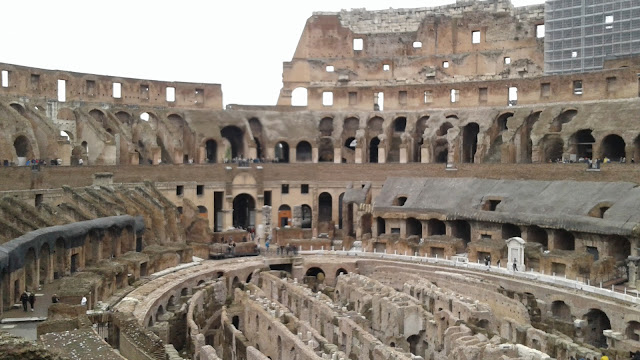


Colosseum

 Another fine example of the use of arches in construction is the Pantheon.  The Pantheon holds the distinction of being the best preserved monument from ancient Rome.  Originally a temple for the Roman Gods the Pantheon is now a Catholic church.  Amazingly, nearly 2000 years after the Pantheon was built it still has the worlds largest concrete dome that is not reinforced. 

Pantheon


Inside the Pantheon - arches and columns
 

Services are still held at the Pantheon but is also serves as the burial place of of some important folks. Notably the painter Raphael is buried in the Pantheon along with some Kings and a Queen.  The interior marble of the building has largely survived but the exterior marble did not.

With the marble facade missing on the exterior of the Pantheon it is easy to see the arches.  It seems such a simple thing but that simple "architectural" element essentially allowed the creation of the Roman Empire and led the way for modern architecture.  Perfection of arches allowed Romans to build aqueducts that supplied water to Roman citizens, bridges that connected regions allowing expansion of the empire and the massive expansion of building projects.  Romans owed much to that simple arch but so do we as it was foundational. 


Sunday, January 16, 2022

The Vatican

Entrance to the Vatican Museums

 As is well known the Vatican is a completely sovereign city state within the city of Rome.  It has the unique distinction of being the smallest city state in the world both in population (about 825) and size (about 120 acres). Being a theocracy ruled by the Pope it is therefore mandatory that all citizens/ residents of the Vatican be Catholic.  Not only must the citizens and residents be Catholic but all visitor guides must also be Catholic.  Their economy is supported by fees imposed on visitors to the museums and by souvenirs they sell to those same visitors.

Laocoön and his sons

As one of the most visited museums in the world the significant revenue from those visitors fees is easy to appreciate.  In 2019, there were 6.9 million visitors but by 2020 that number had dropped by around 80%!!  2020 saw only 1.3 million visitors as COVID was busy wrecking the world.  There is of course nothing good about COVID but it did mean that when we visited in 2021 we were able to just walk right in - no lines, no waiting and relatively small crowds.  Awesome!!

Raphael "School of Athens"

The Vatican museums are home to some of the worlds most renowned masterpieces of Renaissance art not the least of which is Michelangelo's masterpiece in the Sistine Chapel.  So revered is Michelangelo's ceiling that complete silence is demanded while in the Chapel in order to contemplate the sanctity of the moment.  There are also no photos allowed.  So you must go see it with your own eyes😇.  

Gallery of Maps

There are 54 museums to visit housed in 1400 rooms - needless to say it is impossible to see the immense collection of art in one visit.  All told Popes over the years have collected 70,000 artworks yet only 20,000 of those are on display for the public to view.  Being sailors one of the highlights for us was the Gallery of Maps.  On display are a series of painted maps of Italy that were commissioned in 1580 by Pope Gregory XIII.  Each fresco depicts a region of Italy while the paintings of the ceiling near each area depict important events from that region. 
 

Ceiling in the Gallery of Maps

The Vatican is also home for the Pope or at least former Popes.  Popes usually live in the Apostolic Palace papal apartments but not Pope Francis.  He instead lives in a two room apartment in the Domus Santa Marta which is essentially a hotel inside of the Vatican for housing visitors.  Preferring to live a modest life the current Pope keeps it simple which further endears him to Romans.  Such a beautiful place... we are already planning our return trip.


Sunday, January 9, 2022

ROMA


St. Peters Basilica

Rome -an iconic city of contrasts.  Home to both the largest church in the entire world and the largest ancient amphitheatre ever built - known for violence and death for spectator entertainment.  History abounds around every corner in this magnificent city. Since our flight back to the US was out of Rome  we decided to fly to Rome early and spend a few days visiting the city.  Covid still controls the world so international travel is both more complicated and more expensive.  Despite the Covid burden we were determined to see as much of Rome as possible in three days.

St. Peters Basilica

 What we discovered is that three days is not nearly enough time for a visit to Rome.  As a matter of fact as soon as we left we started planning our return visit!  We did try to see the iconic sites: the Vatican, St. Peters Basilica, the Coliseum, the Pantheon and as many of the Piazzas as we could find.  We had booked guided tours of the Vatican and the Coliseum which we highly recommend.  It just adds so much to hear the history behind what you are seeing.  But then you need to go back a second time for photos as it is difficult to attend to both at the same time.  And again - you really want to be tuned into the guide.  They are walking, talking history books.

St. Peters Square

Due to the pandemic there are not the crowds that are usually seen in Rome so we were able to see far more than we would have in normal times.  We were very grateful that we spent no time standing in lines.  Along with the rest of the world we have seen photos and TV footage of St. Peters Basilica yet still we were  blown away by the sheer immensity and stunning beauty of the church.  The church is the burial place of St. Peter and also holds the tombs of several other popes.  The entire interior is filled with marble sculptures, gilding, paintings and reliefs by Bernini, Michelangelo and others - making it appear more art museum than church. 

 Oculus in St. Peters

 To see one beautiful sculpture is a gift - to see an entire cathedral full of the most beautiful architecture and sculptures imaginable is almost more than you can take in.  For us it was like seeing the Sistine Chapel - you are just so overwhelmed that it leaves you speechless.  Of course, St. Peters Basilica is a UNESCO world heritage site as is pretty much all of Rome.

Inside St. Peters Basilica

We were visiting St. Peters in the evening after a tour of the Vatican.  As such, there were only a few people inside allowing us more time to contemplate.  Yet, still not enough time to take it all in.  That would take many, many more days, if not years.

Inside St. Peters Basilica

Sadly, due to the lighting photos were not great.  Especially of Michelangelos  - "The Pieta".  The Pieta is the only work that Michelangelo ever signed.  It is a heavenly gift to us all that we are privileged to behold.  Sadly, the Pieta had to be put behind bulletproof glass as someone attacked the sculpture with a hammer.  It has been restored and protected.  Unfortunately, the protective glass box makes it more difficult to view the piece.


The Throne of St. Peter - Bernini


A visit to St. Peters Basilica alone is a perfect reason to visit Rome.  Photos just do not do it justice.  You have to see it in its entirety - not just a small snapshot. However the entire city is a stroll through the renaissance that is unforgettable.  There are many, many reasons to visit Rome but a visit would be incomplete without a walk through St. Peters Basilica.  


Thursday, December 16, 2021

Alfonsino Castle aka Argonese Castle aka Castello Rosso...

Castello Rosso

Marina di Brindisi owes a lot to their concierge - Greta.  One of the many recommendations from Greta was the "Red Castle".  We see the castle every day so it seemed only fitting that we walk the short way over and participate in an inside tour.  We were not disappointed.

The inside port of Castello Rosso

The port of Brindisi is now and has always been an important, deep water natural port.  The name of the city is actually named for the shape of the port which is said to be the shape of a deers antlers.  In 1481, Ferrante of Aragon felt it was important to build a fortress to guard the port from the Turks.  Hence, it is called the Argonese Castle.  But then in 1485, Alfonso of Calabria transformed it into a real castle.  Hence, it is called the Alfonsino Castle.  The castle was constructed of Carparo blocks that take on a reddish hue when the sun sets behind it.  Therefore it is also referred to as the "Castello Rosso or Red Castle".  Many names - one castle.  

Embrasures for cannons

Castello Rosso was a defensive castle and they actually shot the cannons from INSIDE the castle.  You can see all the openings for the cannons.  Seems like a poor idea until you consider the thickness of the castle walls.  They are an astonishing 2.5 meters (8 feet) thick!!  Both the trapezoidal shape and the thickness of the walls made the fortress impregnable.

Dining Hall - Castello Rosso

But they found that invading forces would just sit in the harbor engaged in a waiting game.  So a fortress was built to house fighting troops.  Forte A Mare (the garrison) housed troops all the way up to 1984.  Castello Rosso/ Forte A Mare has never been taken.  Even during WWII when the castle was attacked it was not taken.  Which is good as it guards a very important and useful port.

The added garrison - Forte A Mare

The garrison (Forte A Mare) was more like several mini apartments.  Soldiers stationed here would sometimes have their families with them as they would live at the Castle/Fort for extended periods of time.

Forte a Mare

Castello Rosso is currently undergoing some extensive restoration.  Currently, visiting the castle is only possible if you have scheduled a time in advance.  While the Castle is well worth a visit now, visiting after the restoration is complete will be even better.  

The entire town of Brindisi is well worth a visit - likely not high up on the list of places to visit by tourists but a truly historic town.